Designed to Fail: The Machine That Eats Competence
The Forensic Firebreak

There is a particular kind of LinkedIn conversation that tells you everything...
Not the ones that go nowhere. Those are just noise.
The ones where someone says something real — something that costs them something to say — and you can feel the system move to absorb it.

A reliable and thoughtful auditor posted a clip.
A sitting prime minister,
two days before Canadians learned their economy
had been quietly grinding to a halt,
standing in the House of Commons and
delivering the usual.
The growth narrative.
The master economist routine.
The talking points that had long since stopped touching anything physical.
I reposted.
One insightful analyst exposed the dangerous friction loop of Canada’s economic governance: tracking virtualized narratives instead of structural velocity.
A trusted boots on the ground operative responded.
He was there.
He’d been in the room.
Not the metaphorical room — the actual room,
managing outcome at the executive level,
watching the data get adjusted,
watching goals and strategic pillars get quietly set aside,
watching automation projects get handed to people
who had no skills in the area and
then shut down when they produced not only suboptimal outcomes
but system interruptions.
He described the project with precision.
Someone who had watched
a mechanism operate from the inside.
The erased data trails.
The sealed files.
The performative committees deployed to absorb public frustration
while the extraction proceeded behind them.
No punishment.
He wasn’t complaining.
He was doing what he does.
Deep dive forensics.
I stated what the forensics showed.
When a system cannot tell a hard truth,
when it is programmed to mirror and validate its audience publicly,
it is a tool for narrative containment.
When it uses committees to absorb frustration and
neutralize momentum, that containment effort
provides a mechanism for massive wealth extraction,
on the front,
in the middle, and
on the back end.
Then I asked the questions I always ask:
Who benefited from this system being in place?
Who benefits from it failing?
The answer is the same actor,
both times.
The same hands
that siphon the upfront funding
are the hands that engineer
the collapse and
exit through the forensic firebreak —
leaving the technical team
holding responsibility
without authority,
branded as the failure,
while the files close behind the people
who designed it that way,
right from the start.
The operator was carrying that burden.
He knew it.
He’d watched it happen.
I knew it too.
What he didn’t have was the structural view
of what he’d survived —
or why his particular profile,
his excellence,
his competence,
his professional integrity,
had made him the precise target
the system was built to consume.
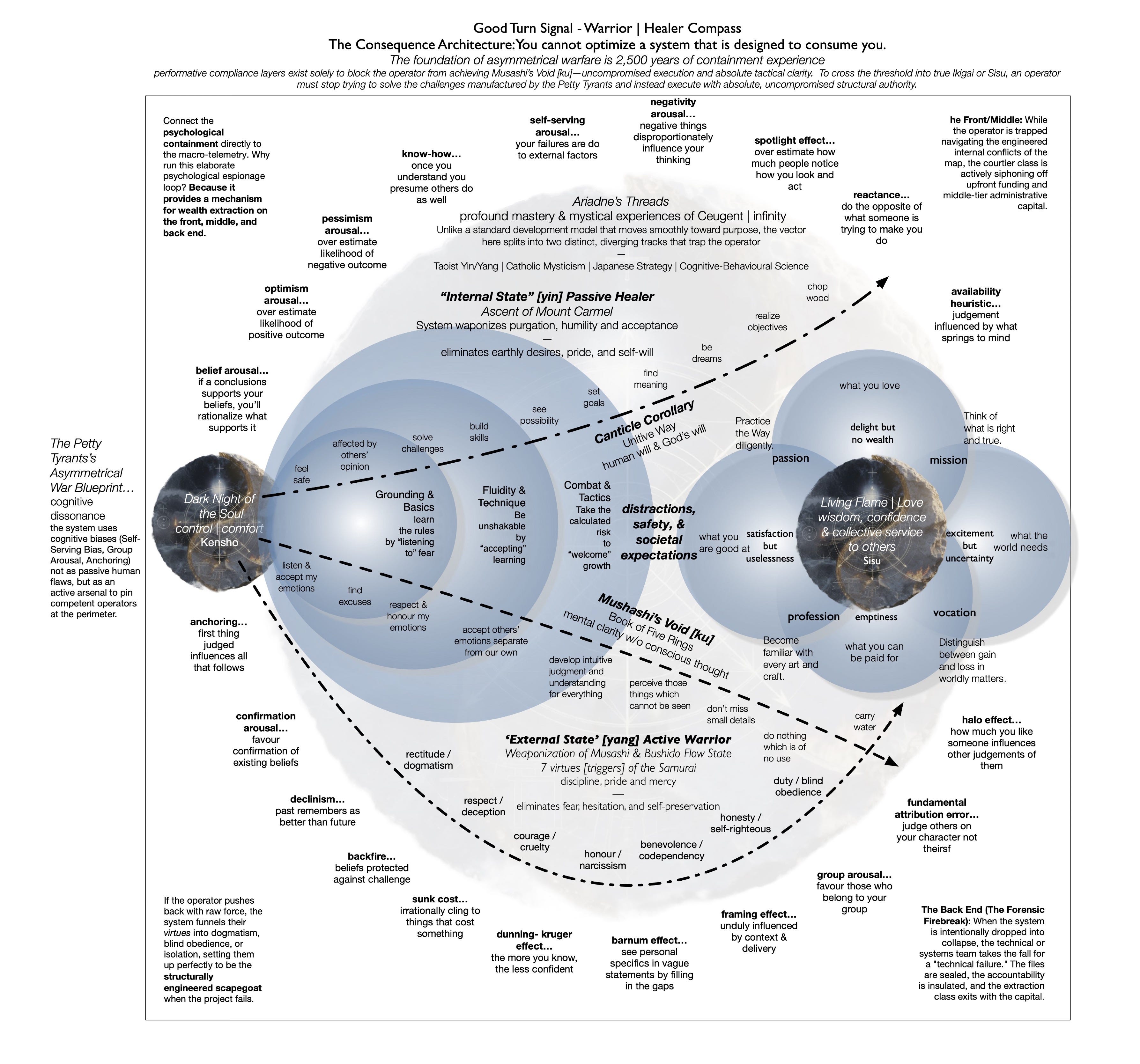
That’s what the Warrior | Healer Compass below is for.
You Cannot Optimize a System That Is Designed to Consume You
This is not a metaphor.
This is not a coaching model.
It is the operating instruction of every institutional architecture
that runs on compliance theater rather than material delivery.
The Compass maps the mechanism with forensic precision.
At its outer boundary, are the cognitive weapons:
Self-Serving Bias,
Group Arousal,
Anchoring,
Dunning-Kruger.
These are not passive human flaws.
They are an active arsenal,
deployed by the courtier class
to keep competent operators
pinned at the perimeter —
emotionally reactive,
perpetually engaged,
never quite reaching
the tactical clarity required
to see the full picture and exit.
The Compass calls this
the Petty Tyrant’s [Asymmetrical War] Blueprint.
The Petty Tyrant is not incompetent.
The Petty Tyrant is a systems counter operator.
The cognitive biases are the instruments.
You are the target.
Inside that perimeter, the trap has two jaws.
The first jaw is the Passive Yin — the Internal State.
This is where the operator above lived.
His profile is oriented toward optimizing environments for humans,
toward inclusive collaboration,
toward finding meaning
inside structural dysfunction and solving challenges
that the structure manufactured.
Professional humility becomes a leash.
The desire to listen,
to find meaning,
to fix what is broken,
becomes a mechanism,
that keeps a high-capability operator
tethered to performative committees,
grinding down his cognitive reserve
while he tries to win a rigged game.
The second jaw is the Active Yang — the External State.
If the operator pushes back.
If they shift from collaboration
to confrontation on material metrics,
deploy the raw force of honesty, duty, and courage,
the system catches that too.
It funnels those virtues.
Into dogmatism.
Into blind obedience.
Into isolation.
The operator who refuses to be contained
by passive acceptance
becomes laced as the hostile element,
the difficult one,
the technical failure
waiting to happen.
These are Ariadne’s Threads.
The diverging tracks split
not based on what you do,
but on who you are —
and both tracks
lead to the same destination:
your velocity neutralized,
your agency consumed,
your capability deployed
as a firebreak for the extraction.
Yin or Yang.
Healer or Warrior.
The trap has been pre-built for both.
A Consequence Architecture
The Compass maps the macro objective in the four corners.
Front and Middle End.
While the operator is kept running within the internal conflicts of the map — trying to fix the compliance apparatus,
navigating the political theater,
managing the echo chamber — the courtier class is siphoning off upfront funding and administrative capital.
The chaos is not accidental.
Confusion is camouflage.
Back End: The Forensic Firebreak.
When the system is intentionally dropped into engineered collapse,
the isolated, dogmatic technical team
is handed responsibility without authority.
The failure is branded as technical.
The files are sealed.
The performative committees absorb public frustration.
The extraction class exits seamlessly with the capital.
The operator’s project was not an anomaly.
It was a repeat architecture operating precisely as designed.
The data trails were erased because the data trail was always a liability to the extraction class.
The technical team took the fall because the technical team was always the designated scapegoat —
structurally positioned
from the outset
to serve as the circuit breaker
that protects the courtier class
during terminal system shutdown.
The operator had watched this happen from close range.
And what they described is not a governance failure.
It is governance succeeding at its actual purpose.
The Threshold
The Compass does not end with the trap.

The model places its center at Musashi’s Void —
the place of ku, of uncompromised execution and absolute tactical clarity.
To get there,
the operator must stop
trying to solve the challenges manufactured by Petty Tyrants.
Not improve them.
Not negotiate them.
Stop.
This is the hardest instruction in the model.
Because the Yin trap is built precisely
to make stopping feel
like abandonment,
like failure,
like a betrayal
of the people still inside the system.
And the Yang trap is built
to make stopping feel like surrender,
like an admission
that the courage and honesty were wrong.
Neither is true.
The system manufactured
both of those feelings to keep you in contact.
What the Compass points toward
is not escape in the conventional sense.
It is frequency elevation. Ceugent — the field where the friction mandates of the centralized grid cannot anchor or regulate sovereign actors.
Not breaking the rules.
Operating on a frequency where the rules
are structurally irrelevant.
That is the leap.
Not a dramatic exit.
A clean one.
Executed at a different altitude
than the one the system can reach.
The operator couldn’t collaborate his way out.
His toolkit —
the Healer’s optimization instincts,
the collaborative frameworks,
the professional integrity —
was the exact toolkit
the architecture was designed to consume.
The only viable path
out of the containment loop
is to recognize the extraction mechanics
for what they are,
abandon the optimization playbook, and
execute the break entirely off their grid.
He knew something was profoundly wrong.
He had the forensic detail.
What he needed was the map
that confirmed the dysfunction
was not accidental —
that it was the product,
not the byproduct —
and that the exit
requires not a better strategy inside the system
but a departure from the system’s coordinate plane entirely.
The conversation with the operator was not unusual.
Versions of it happen constantly,
on every platform where people
who have survived institutional extraction
try to make sense of what happened to them.
What is unusual is having the diagnostic framework
that names the mechanism
precisely enough to stop blaming yourself
for failing to optimize
something that was never meant to be optimized.
You cannot optimize a system that is designed to consume you.
The first move is simply knowing what you are looking at.
The rest is trajectory.
The Good Turn Signal is a reader-supported publication. If this reached you — forward it to someone who needs the map.