The Blindside Turn Signal
When the Indicator Light Turns On, You Don’t Admire the Bulb—You Inspect the Architecture.

Act I: The Indicator Light
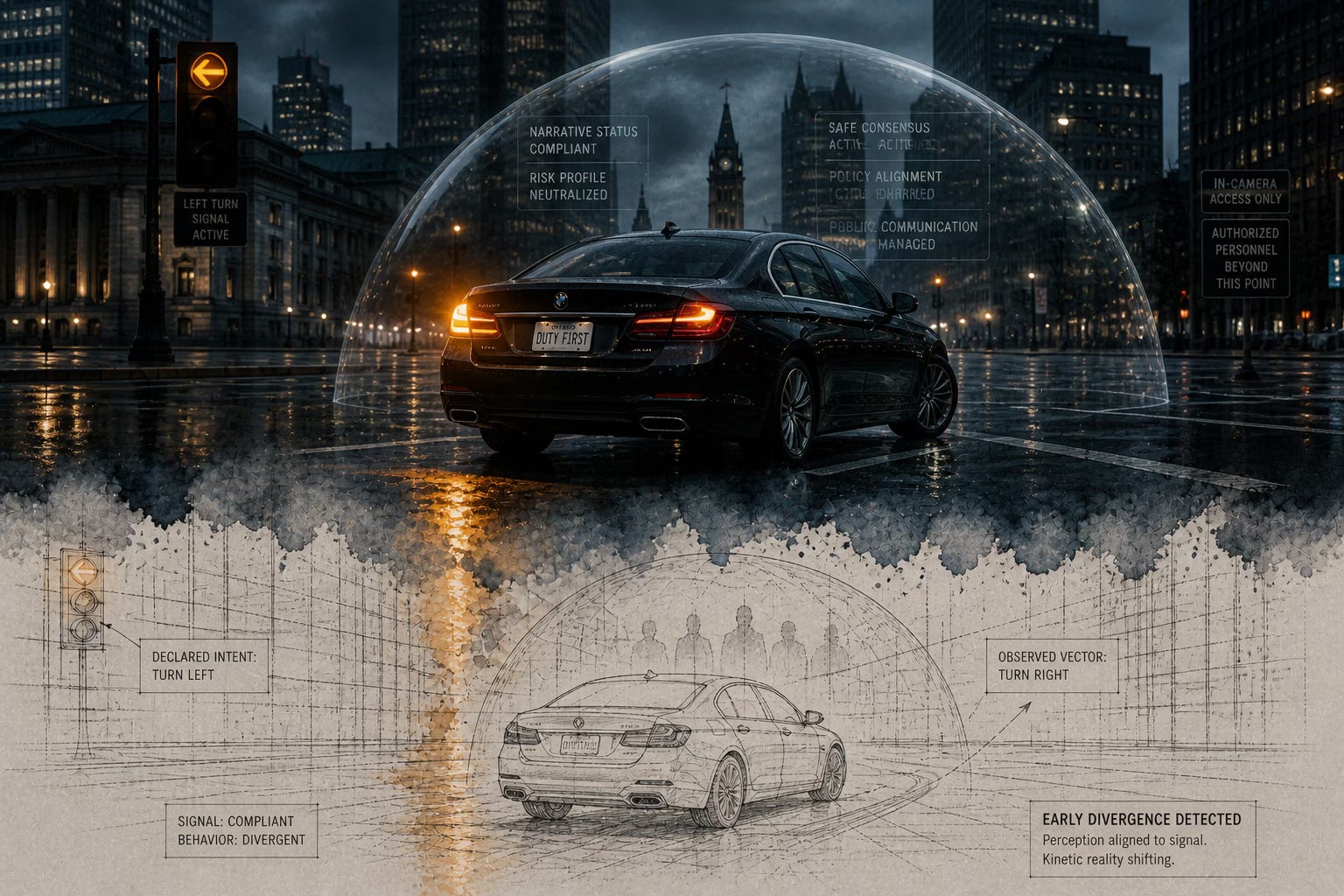
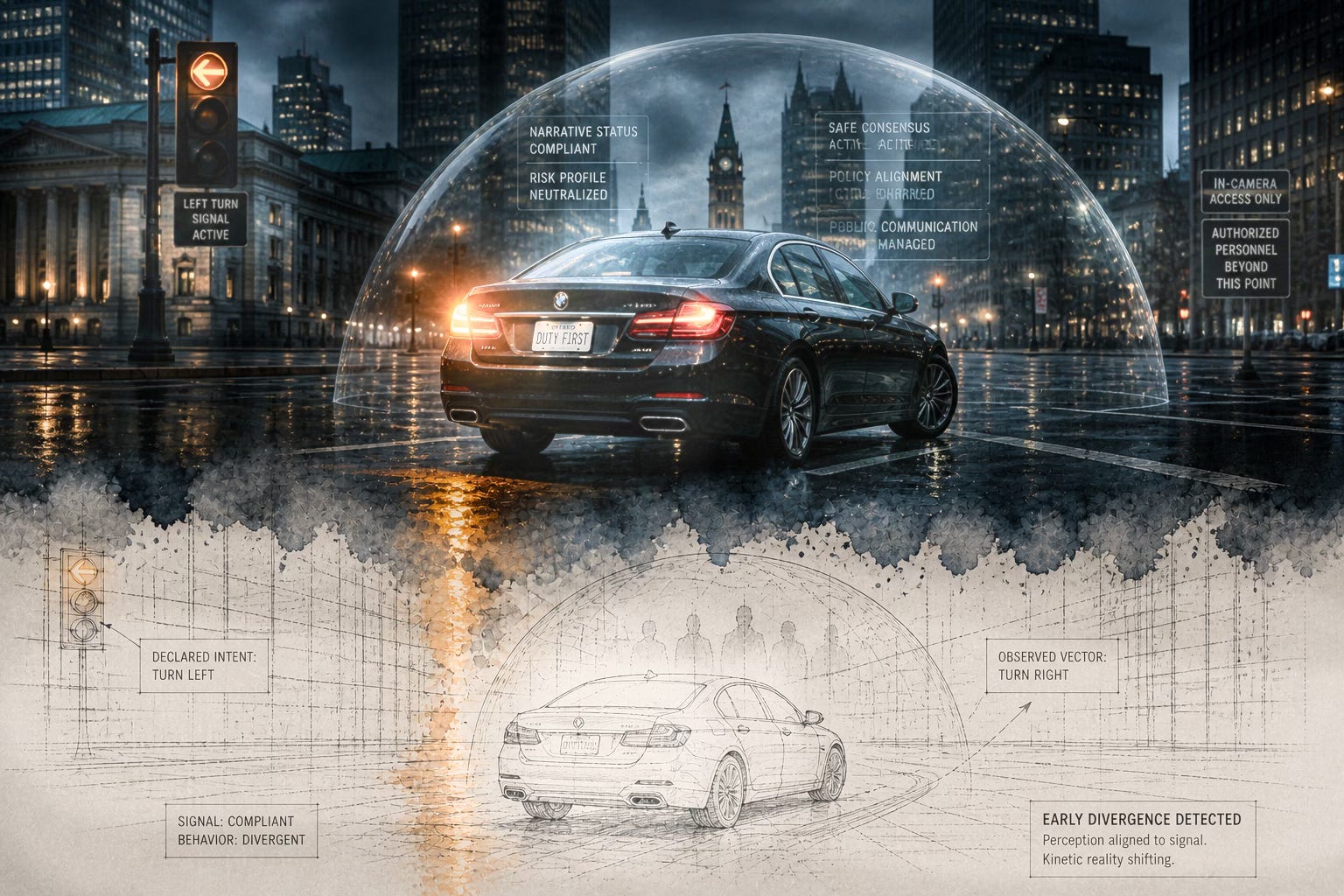
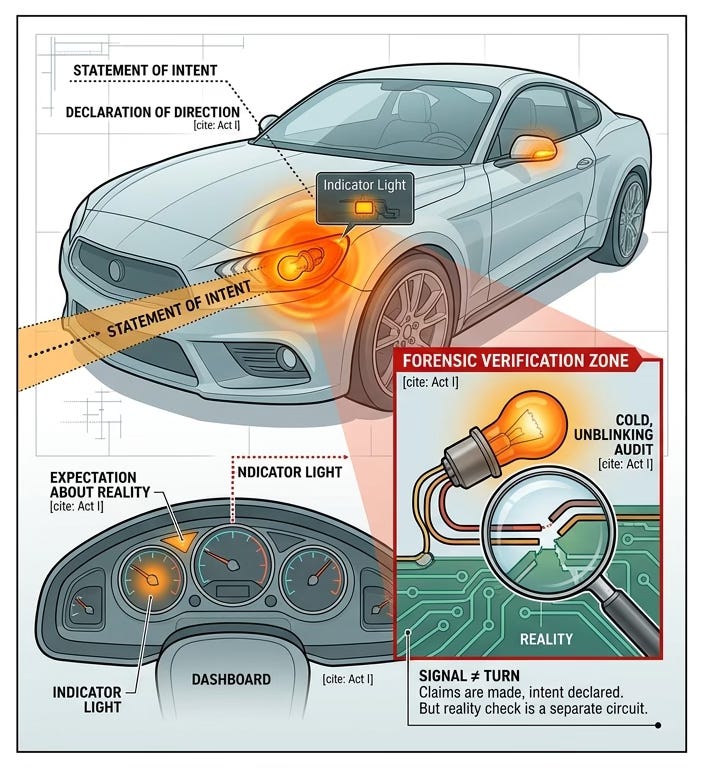
A turn signal is not the turn.
It is a claim,
of a potential turn.
A statement of intent.
The declaration of where someone says they are going.
Good drivers know the difference.
Because the purpose
of a turn signal is not to reveal reality;
its purpose is to communicate
an expectation about reality.
Turn signals can be profoundly misleading.
They can remain blinking
cheerfully
long after the steering column has snapped,
the engine has seized, or
the destination has been abandoned.
They can point due north
while the vehicle’s physical momentum
is already skidding sideways into a ditch.
Which is why every signal deserves a cold,
unblinking verification.
The corporate masters at Honda
recently flashed an unmistakable warning light,
indefinitely suspending part of their planned $15-billion electric vehicle and battery complex in Ontario
due to global restructuring losses.
Instantly, the grand,
green-washed machinery
of state public relations
sputtered to life to manage the fallout.
The government signaled unbroken confidence;
industry groups signaled bountiful opportunity;
investors signaled caution; and
China, with quiet, terrifying efficiency,
signaled acceleration.
Everyone signalled.
The confronting question
is not which signal we prefer
while we sip our coffee,
but which one survives
a high-velocity contact with reality.
To find out,
we must see the “check engine light”
for what it is.
Not of the media narrative,
nor of the government and
corporate press releases,
but of the raw telemetry.
The facts, as they are printed
on the glossy,
taxpayer-funded brochures,
are straightforward.
Honda’s planned Ontario investment
was positioned as the cornerstone
of a national industrial strategy.
The federal and provincial governments
have committed billions of the public’s resources
to attract battery manufacturing,
vehicle assembly, and
critical mineral processing.
The rationale sounds clean:
transportation is being electrified,
global supply chains are being violently reorganized, and
nations are competing for strategic slots
on the factory floor of tomorrow.
Canada, we are told,
possesses the raw ingredients:
critical minerals,
engineering talent,
stable institutions,
access to North American markets, and
a legacy of automotive expertise.
Viewed from the gallery,
the strategy looks like a well-formed machine.
The stated direction is clear.
Now, let us turn the inspection panel screw and
look at the gears.
It is a multinational corporation
with an unyielding fiduciary obligation
to allocate capital
where risk-adjusted returns are highest.
Honda is not a public agency.
It is not a sovereign wealth fund.
It is not an instrument designed to fulfill Canadian industrial policy.
That is not a moral failing; it is governance.
When global market demand forecasts change, or
when competitive conditions shift,
capital allocation changes.
This introduces
a deeply uncomfortable question:
If a change in the plans
of a single foreign-headquartered multinational
can materially derail the trajectory
of an entire national industrial strategy,
what exactly did we build? And for whom?
The issue stops being about Honda.
It becomes a diagnostic
of our own engineering.
A forensic audit forces us
to look squarely into
three profound structural chasms:
The Fiduciary Gap: The stated objective is sovereign industrial capacity, yet the operating reality relies entirely on investment decisions made completely outside national control. The wider that distance, the greater the gap.
The Proof Gap: Announcements are not outcomes. Projected jobs are not operating facilities. Memoranda of understanding are not production. Forecasts are not evidence. The proof gap is the cold distance between what is anticipated in a press conference and what is actually observable on the shop floor.
The Veto Point: Every complex system contains a hidden junction where momentum can be stopped cold. Sometimes it is regulatory permitting, sometimes it is energy availability, sometimes it is capital, and sometimes it is shifting global demand. The Honda story reveals a critical vulnerability: the ultimate ability to alter the trajectory of the nation’s industrial ambitions does not reside within the state.
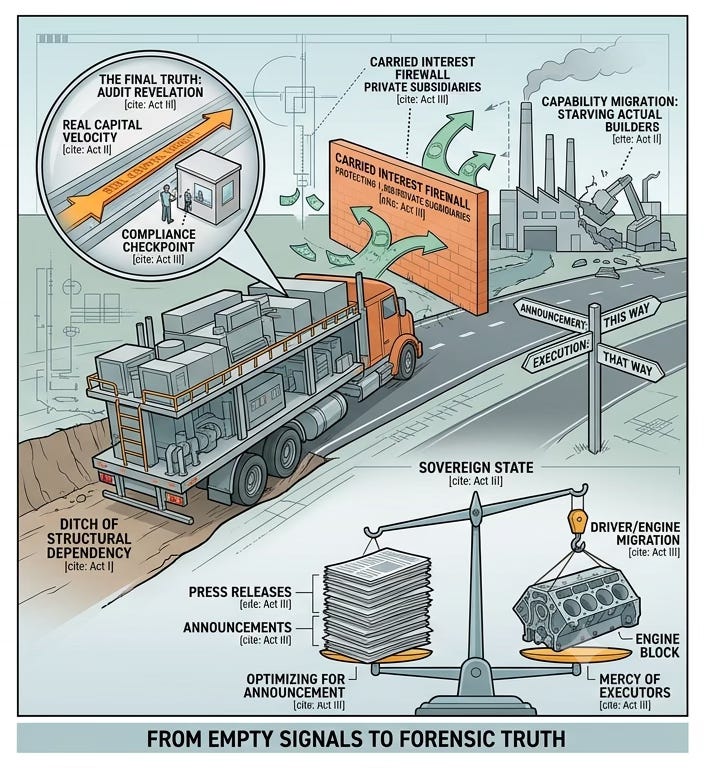
The indicator light is warning us
to look past the automobiles.
The exact same gaps and veto points apply
to our approach to:
artificial intelligence,
energy infrastructure,
critical minerals,
housing,
defense procurement,
advanced manufacturing, and
collapsing national productivity.
The underlying economic telemetry tells the real story.
The Canadian domestic engine
is currently sitting at a disastrous
Incremental Capital-Output Ratio (ICOR)
of 15.
We are pumping
two to three times
the capital into this system
just to secure the basic economic return,
clearing the way
for administrative parasites
while starving actual builders.
A nation can subsidize activity without creating resilience.
It can attract transient investment without building genuine sovereignty.
It can celebrate its own announcements while quietly accumulating deep structural dependency.
But eventually.
Sovereignty follows execution.
Capital follows execution.
Talent follows execution.
Innovation follows execution.
When the indicator light turns on,
you don’t stand there admiring the bulb.
You inspect the architecture.
Act II: Anatomy of the Capital Efficiency [transmission] Drain
The modern compliance framework
treats a blind trust
as a system of public accountability.
But a forensic audit
classifies it as something
entirely different:
an architecture of asymmetric insulation.
Consider the Geopolitical Canola-for-EVs maneuver executed earlier this year.
The federal government negotiated
a trade arrangement with Beijing,
slashing import tariffs
on Chinese electric vehicles
from 100% down to a country-specific quota rate of 6.1%
for up to 49,000 units.
This was sold to the public
as a defensive shield
to protect Western agricultural producers—
specifically a $4-billion market
of Canadian canola seed exports—
from crushing trade retaliation.
But raw telemetry doesn’t care about agricultural press releases.
Look beneath the hood,
and the regulatory lever
perfectly aligns
with the asset layout
of one auspicious global private equity company.
This tariff adjustment
didn’t just move agricultural products
across the Pacific;
it directly stabilized
the cash-flow architecture
of Clarios,
a tier-1 battery giant
embedded deep within the asset portfolio
of Brookfield.
Clarios
does not simply build standard car batteries;
it dominates the advanced 12V low-voltage system architecture
that is technically required
by Chinese EV manufacturers
inside their domestic supply chains.
While domestic assembly plants
like Honda
halt localized projects
on Canadian soil,
the state’s regulatory levers
are effectively optimized
to derisk global private assets
operating abroad.
A blind trust sounds great.
But it doesn’t erase a structural architect’s knowledge
of exactly where those policy levers are placed;
it merely ensures
that when the capital velocity shifts,
the public ledger
remains blind
to the connection.
The Disclosure System - The Legalized Illusion
Blind trusts
prevent an official
from executing daily market trades.
It cannot erase a structural architect’s knowledge
of which policy levers
lift the terminal value
of those assets.
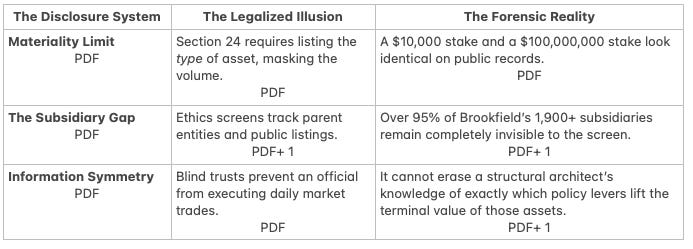
To treat a blind trust like a bureaucratic checklist
to be polished
is an institutional trap.
And, when you look at a system sitting at a capital efficiency ratio (ICOR) of 15,
you are not looking at passive inefficiency
or accidental bureaucratic bloat;
you are looking at a machine
that has been deliberately re-engineered
to divert capital away from domestic execution and
toward private,
global equity targets.
Act III: Carried Interest Firewall protecting 1,900 private subsidiaries
The institutional debate
always fixates on the wrong numbers.
Public accounts and media watchdogs
point to specific, disclosed tranches—
like the 409,300 unexercised options expiring in 2033—
as proof that the ethical boundaries are clearly marked.
This is a deliberate distraction in the way
$6MM is not the same as $600MM.
In the architecture of modern macro-finance,
options are rounding errors.
They are peanuts
thrown to the gallery
to keep them looking at the stage.
The true engine of wealth generation
is the back-end carried interest
carved out of massive,
global transition funds.
Because these funds
operate within a nested labyrinth
of over 1,900 private subsidiaries,
they completely bypass
the statutory disclosure limits of Section 24.
The entity-mapping deficit
is a feature of the system,
not a bug.
It allows a sovereign administrator
to dictate national economic strategies and
execute international trade rebalancing
while their private equity vehicles
capture the yield generated
by those exact policy shifts.
When a system is engineered this way,
capability does not stay home,
capital does not stay home,
profits do not stay home.
It migrates to where the returns are insulated.
Honda’s sudden turn signal
isn’t an isolated corporate delay;
it is the natural consequence
of a national engine
that has been rewired
to feed parasites
while starving actual builders.
We can trade our institutional drag
for public infrastructure and
celebrate the announcements, but
if we do not possess the capacity
to execute independently,
we are simply managing our own decline.
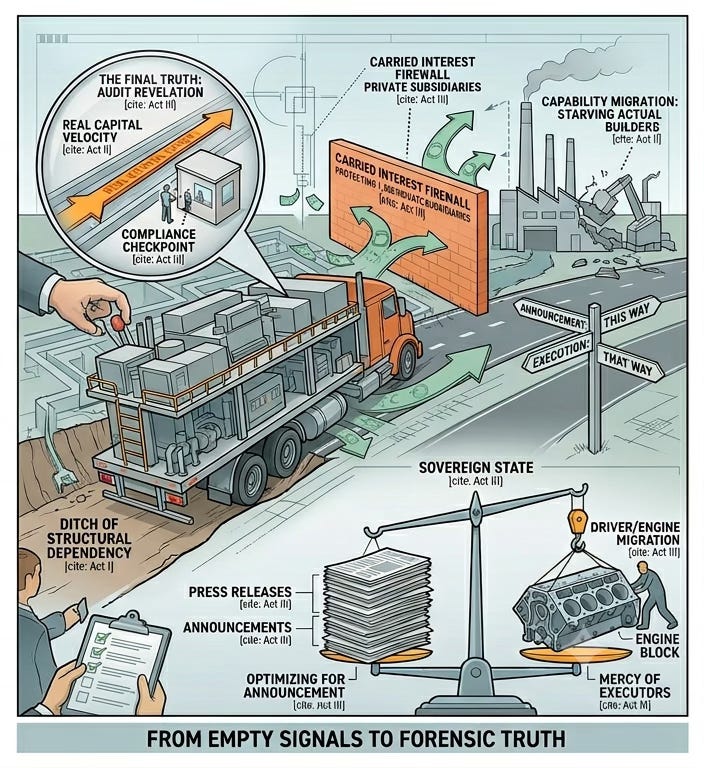
The Honda story
may ultimately prove temporary;
the investment may proceed,
the market may recover, and
consumer demand may strengthen.
Those outcomes matter to quarterly reports.
But they are not the most important insight.
We are left with the blinking light.
The sovereign state standing
on the shoulder of the highway,
clipboard in hand,
checking off the boxes
of its compliance forms
while the real capital velocity
roars past at eighty miles an hour
in an entirely different direction.
We have built an exquisite stadium for spectators,
but we forgot how to field a team
that knows how to run the ball.
And that is the final truth the audit reveals.
A nation that optimizes
for the announcement
will always find itself
at the mercy
of those who optimize
for execution.
The turn signal
keeps flashing,
rhythmic and empty,
blinding us
to the fact that
the driver left the vehicle
three exits ago,
taking the engine with him.