The Great Canadian Squeeze
Sovereign Substitution, Globalist Arbitrage, and Emergent Operational Architecture

For decades, the standard playbook for Canadian
enterprises,
operators, and
institutional investors
relied on a predictable set of assumptions:
stable North American trade corridors,
a predictable demographic baseline, and
an implicit sovereign backstop
that insulated the domestic economy from acute structural shocks.

Today, that playbook is obsolete.
Canada is caught
in an unprecedented macroeconomic bottleneck—
a structural squeeze
exploding statutory costs,
capital starvation, and
a dangerous sovereign attempt
to artificially subsidize
an uncompetitive domestic ecosystem.
For those building at the coalface
of markets and moonshots,
navigating this environment
requires moving past legacy planning.
It requires understanding
the exact fiscal telemetry
of the sovereign trap,
recognizing how global capital escapes it, and
deploying an agile, operational architecture
to survive and thrive amidst chaos.

The Sovereign Trap
The Macroeconomic Bottleneck
To understand the squeeze,
one must look directly at the sobering demographics and
statutory commitments of the Canadian state.
The baseline of the economy
is fundamentally compromised:
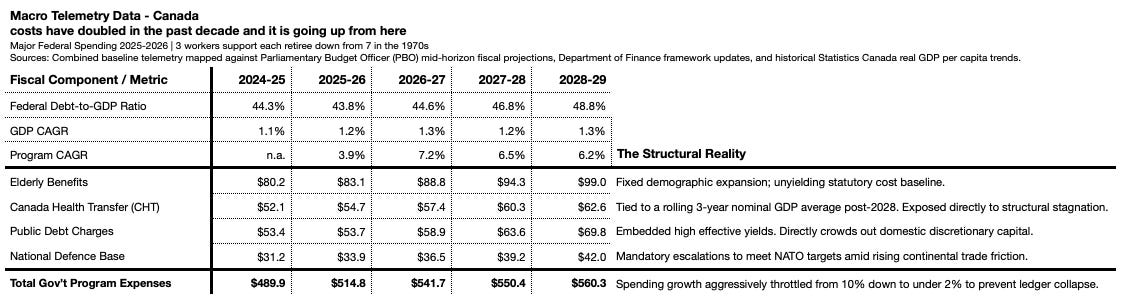
there are now only 3 workers
supporting each retiree,
a sharp drop from 7 in the 1970s.
This fixed demographic reality
enforces an unyielding statutory cost baseline
that no amount of short-term fiscal tinkering can bypass.
According to Parliamentary Budget Officer (PBO)
mid-horizon fiscal projections,
Elderly Benefits alone
are locked on a relentless upward trajectory,
expanding from $80.2 billion in 2024-25 to $99.0 billion by 2028-29.
Concurrently,
decades of accumulated debt
combined with higher structurally embedded interest rates
mean that Public Debt Charges
are surging from $53.4 billion to $69.8 billion
over the same horizon.
To prevent ledger collapse and
avoid a complete downgrade
of the sovereign debt rating,
the state is forced to aggressively throttle
total government program spending growth,
squeezing it down
to ensure statutory obligations
can be met.
The Capital Trap and the ICOR Crisis
Compounding these demographic liabilities
is a catastrophic domestic capital investment crisis.
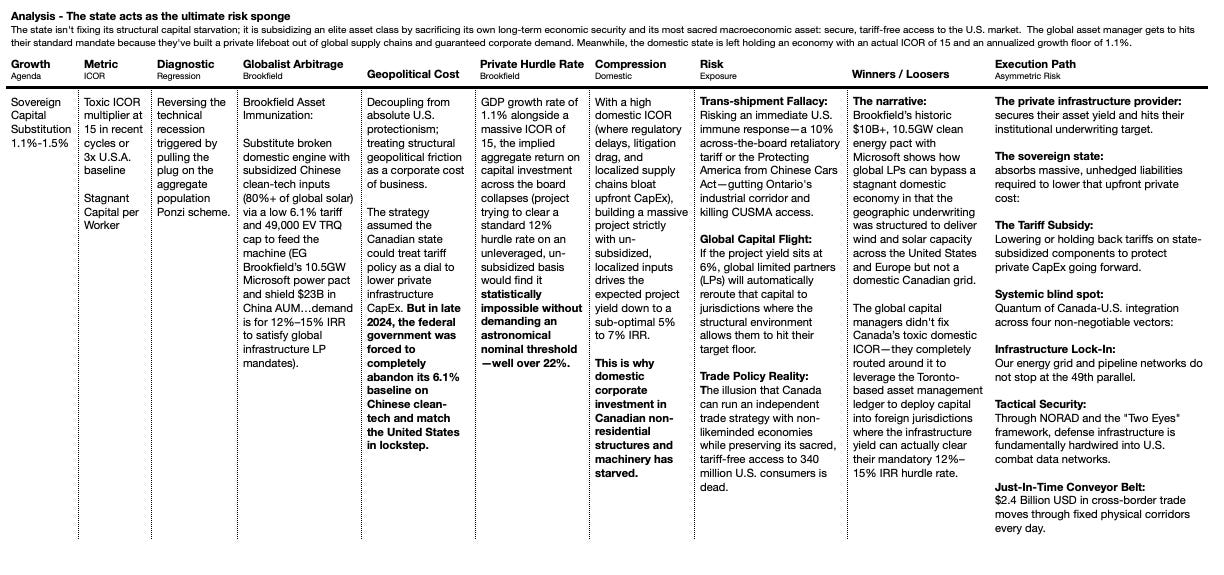
Canada suffers from a toxic
Incremental Capital-Output Ratio (ICOR)
of 15 in recent cycles—a measure of the capital required to generate a unit of output.
This ICOR is roughly
triple that of the United States,
meaning the Canadian economy
is incredibly inefficient
at turning capital investment
into tangible economic growth.
Regulatory drag,
litigation timelines, and
localized supply-chain friction
bloat upfront CapEx
to such a degree
that typical domestic projects
struggle to clear a meager 5% to 7% IRR.
Yet, to clear a standard institutional
unleveraged hurdle rate of 12% to 15%
in an environment with this level of friction,
projects would require nominal returns
that are practically non-existent in a
stagnant domestic market.
As a result, domestic corporate investment
in non-residential structures and machinery
is severely starved.
Globalist Arbitrage and the “Risk Sponge”
Faced with a toxic ICOR and sub-optimal domestic returns,
elite domestic and global capital managers
are executing a masterclass
in globalist arbitrage rather than attempting
to fix the domestic economy.
They use their Canadian-domiciled ledgers
as an administrative base,
but route their capital
directly into foreign jurisdictions
where infrastructure and energy yields
can actually clear their mandatory 12%–15% (UE / UK)
institutional underwriting hurdles.
A Story to Illustrate: The Ledger Stays. The Power Plant Doesn’t.
In mid 2024, Brookfield Asset Management —
headquartered in Toronto,
run substantially out of Canadian capital and
Canadian institutional relationships —
signed one of the largest clean energy agreements
in corporate history:
multi-billion-dollar,
10.5-gigawatt power deal
with Microsoft.
It’s the kind of announcement
that gets read as a Canadian win.
Canadian company,
historic deal,
clean energy,
AI infrastructure —
all the buzzwords line up.
The press release writes itself:
domestic champion,
global stage,
green transition,
the works.
Then you look at where the gigawatts are going.
The wind farms,
the solar arrays,
the grid interconnects —
all of it
is being built across the United States and Europe.
The asset manager is Canadian.
The capital pool drawing on Canadian pension and
institutional relationships is Canadian.
The 10.5 gigawatts of actual, physical,
steel-in-the-ground infrastructure is not.
Why the Power Plant Left and the Ledger Didn’t
Brookfield didn’t do anything wrong, and
didn’t do anything unusual.
It did exactly what a fiduciary
is supposed to do:
it found the jurisdictions
where the math works, and
it built there.
Understanding why requires walking through three layers —
the return gap, the routing logic, and
the state’s shrinking ability
to do anything about either one.
Layer One: Domestic Projects Don’t Clear the Bar
Large infrastructure investors —
pension funds,
sovereign-adjacent vehicles,
institutional limited partners,
operate under mandates that typically require
unleveraged returns
somewhere in the 12-15% range.
That’s not an aggressive target.
It’s closer to a floor:
the threshold below which a fund manager can’t honestly tell their own beneficiaries that the capital is working as hard as it should be.
A Canadian infrastructure project,
once you account for permitting timelines,
litigation exposure,
environmental review processes, and
the patchwork of provincial and federal approvals
layered on top of each other,
tends to land somewhere in the 5-7% range
on an unsubsidized basis.
That’s not a small gap.
It’s the difference between “fundable” and “not,” and
it’s a gap that exists before anyone has made a single bad decision
about the underlying project itself.
The wind is the same wind.
The sun is the same sun.
The difference is entirely in what it costs,
in time and dollars and legal exposure,
to get from “we’d like to build this” to
“this is generating revenue.”
Economists have a rough shorthand
for describing this kind of friction:
how much capital investment
a country needs
to produce one additional unit
of economic output.
By that measure, Canada currently needs
roughly three times what the US needs
to produce the same result.
Call it capital drag.
Call it regulatory friction.
Call it red tape
if you want the politically loaded version —
the practical effect is identical.
Every dollar of Canadian infrastructure capital
does less work here than the same dollar
would do somewhere else.
Not because the dollar is different.
Because the operating environment is.
Layer Two: When the Math Doesn’t Work, Capital Doesn’t Wait — It Routes
This is the part that’s easy to miss
if you’re reading the Brookfield deal
as a story about underinvestment.
It isn’t.
The natural assumption
is that Canadian infrastructure
is starved for capital —
that there’s a pool of money sitting on the sidelines,
waiting for permitting reform or political will or
some future government
to fix the friction described above,
at which point it will flow in.
That’s not what’s happening.
The capital isn’t waiting.
It’s already moved.
The Brookfield-Microsoft deal
isn’t capital failing to find a home in Canada.
It’s capital that found a home — just not here.
The ledger entry says Toronto.
The institutional relationships,
the reporting, the corporate registration,
all of it says Toronto.
The concrete says Texas, and Spain, and
wherever else the 10.5 gigawatts of wind and solar
are actually rising out of the ground.
This is worth sitting with,
because it inverts the usual framing.
The usual framing
treats Canadian capital flight
as a future risk —
something that might happen
if conditions don’t improve.
But the framing assumes
the capital is still here,
deciding.
It decided.
The decision already happened.
It happened at scale.
It happened through one of the most Canadian-identified
financial institutions in the country.
If the largest, most sophisticated,
most domestically-rooted pools of capital in Canada
have already concluded that the math doesn’t work here and
built somewhere else instead,
that’s not a warning sign about the future.
That’s a description of the present.
Layer Three: The State Tries to Close the Gap, and Runs Into Its Own Ceiling
Faced with projects
that can’t clear institutional hurdle rates
on their own,
the natural government response
is to subsidize the difference —
buy down the cost of inputs,
backstop construction risk,
narrow the spread between the 5-7%
a project can deliver unassisted and
the 12-15% an LP needs
to see before committing.
This isn’t a fringe idea or
a particular government’s pet project.
It’s the standard playbook,
used across political administrations,
because it’s the only lever available
that doesn’t require fixing
the underlying permitting and
litigation environment —
which is slow,
politically costly, and
involves dismantling things
that took decades to build up.
For a while, this works.
A subsidy here,
a loan guarantee there, and
a project that would have died at 6%
limps across the line at something closer to 12%.
The gap gets papered over, project by project.
But the room to keep doing that is shrinking, and
the reason is demographic,
not political —
which is precisely what makes it harder to argue with.
Canada has gone from roughly seven workers
supporting each retiree a couple of generations ago
to roughly three today.
That’s not a projection or a worst-case scenario.
It’s the current population,
doing what populations do,
arithmetically.
That shift shows up directly in the federal balance sheet,
in the most literal sense possible.
Statutory commitments like elderly benefits
are on a fixed upward trajectory that no government,
of any party,
of any ideological persuasion,
can simply choose not to pay.
These aren’t discretionary line items
that get debated in budget season.
They’re commitments made decades ago
to people who are retired now, and
the bill comes due regardless of what else
is competing for the same dollars.
At the same time, the cost
of servicing accumulated debt
is climbing as carrying costs
reset to higher rates than the debt
was originally issued at.
This, too,
isn’t a policy choice
in any meaningful sense —
it’s the mechanical consequence
of debt issued at one rate
needing to be refinanced
at whatever rate exists when it matures.
Put those two things together —
a statutory commitment
that’s legally locked in and growing, and
a debt-servicing cost
that’s mechanically resetting upward,
and you get a federal budget
where an increasing share
of every new dollar
is already spoken for
before anyone gets to decide
what to do with it.
Total federal program spending
is still going up in dollar terms;
that’s not in dispute.
But the growth rate of everything else —
the discretionary stuff,
the stuff that includes subsidies
for infrastructure projects
that can’t clear 12% on their own —
is being squeezed down hard,
because the non-negotiable stuff
is eating the increase before it arrives.
This is the ceiling.
Not a political ceiling
that a different government
could simply choose to remove, but
a structural one,
built out of demographic arithmetic and
interest rate resets,
that exists regardless
of who’s making the decisions.
Where That Leaves You
Domestic infrastructure projects
can’t clear institutional return thresholds on their own,
because of a return gap that’s structural rather than cyclical.
The state’s traditional tool
for closing that gap — subsidy — is drawing
from a pool of discretionary spending
that’s shrinking in relative terms every year,
for reasons that have nothing to do
with policy preference and
everything to do with demographics and
debt math that’s already locked in.
And the capital that the gap
was supposed to attract has already demonstrated,
at the scale of one of the largest energy deals
in corporate history,
that it doesn’t wait around for the gap to close.
It routes.
If you’re an operator, founder, or allocator
working on anything capital-intensive in Canada,
this isn’t background noise.
It’s the operating environment, and
it has three direct implications.
Don’t build a model that needs the gap closed by subsidy.
Government co-investment, grants,
and backstops are real, and
worth pursuing where available —
but they’re drawing from a pool
that’s contracting in relative terms every year,
regardless of which party is in office or
what they’ve promised.
A project that only works with the subsidy
is a project that stops working the moment
the fiscal envelope tightens further.
And the data says it’s going to tighten further,
on a timeline that’s largely already determined.
“Canadian-domiciled” is not the same as “Canadian-deployed.”
If part of your thesis involves attracting capital from
Canadian pension funds,
asset managers, or
institutional pools because they’re Canadian —
on the theory that domestic capital
has some kind of home-field loyalty —
Brookfield’s own deal is the counter-evidence.
The largest, most domestically-identified
Canadian capital pool in the relevant category
looked at a 10.5-gigawatt opportunity and
built it somewhere else.
The capital will show up
if your project clears 12-15%
on its own structural merits.
It won’t show up because
of where the head office is.
The gap itself is the opportunity.
Every one of these pressures exists
because something doesn’t currently exist:
a way to get a domestic project from 5-7% to 12-15% through structure, rather than through subsidy.
That’s not a reason
to write off Canadian infrastructure — it’s the actual brief.
The fiscal room to subsidize is shrinking
on a schedule that’s already written
into the demographic and debt data.
Whoever can close that gap
without leaning on a state that’s running out of room to help
isn’t fighting the trend the Brookfield deal represents.
They’re the answer to it.
The power plant left because the math told it to.
Nobody’s going to build the next one here by arguing with the math.
They’re going to build it by changing it.
This is part of the Good Turn Signal series —
distinguishing genuine signal
from performed noise
in governance, strategy, and public life.
The CUSMA Paradox and Sovereign Risk
This brings us to the ultimate strategic paradox and
the greatest threat to Canadian operators:
the trans-shipment fallacy.
Canada cannot run an independent,
opaque trade strategy with
non-likeminded economies
while simultaneously preserving
friction-free access
to the United States and its 340 million consumers.
The physical and digital integration
of the North American economy is absolute,
operating across three non-negotiable vectors:
Infrastructure Lock-In: Our energy grids, power pools, and pipeline networks are physically hardwired across the 49th parallel; they do not stop at national borders.
Tactical Security: Through NORAD and the “Five Eyes” intelligence-sharing framework, Canadian defense and communications infrastructure is deeply intertwined with U.S. combat data networks.
The Just-In-Time Conveyor Belt: $2.4 Billion USD in cross-border trade moves through fixed, highly optimized physical corridors every single day.

The Execution Path: Moving Past the Sovereign Trap
The structural reality of the Canadian macro-environment
is no longer a matter of forward-looking debate.
The data is in,
the decisions have been institutionalized, and
the telemetry is unyielding.
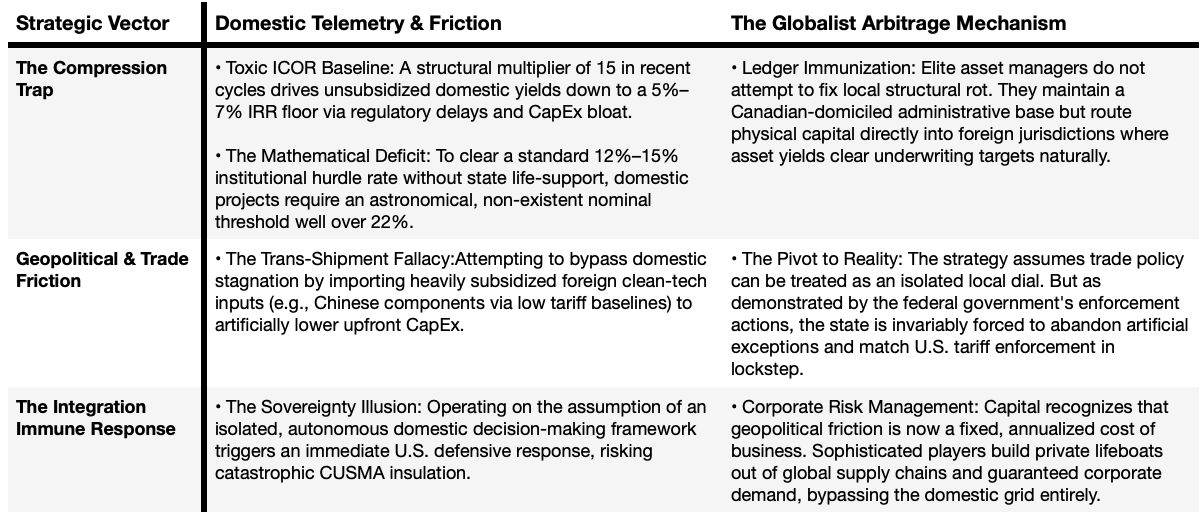
As mapped out
in the Sovereign Capital Substitution Matrix below,
the domestic state has increasingly defaulted
to acting as the ultimate,
unhedged risk sponge.
Faced with an annualized GDP growth floor
locked between a meager 1.1% and 1.3% and
a stagnant pool of capital per worker,
the sovereign is attempting to artificially
buy down structural liabilities
by sacrificing long-term economic security and
its most sacred macroeconomic asset:
secure,
friction-free access
to the U.S. market.
The Capital Substitution Matrix
The Three Non-Negotiable Vectors
For
operators,
founders, and
allocators
building at the coalface
of capital-intensive industries,
navigating this environment
requires an absolute rejection
of performed governance.
Any model built
on the assumption
of a fully isolated,
sovereign Canadian
decision-making sandbox
is fundamentally flawed.
Your operational architecture
must align directly with the three physical and
digital vectors
that hardwire the Canadian economy
to the U.S. demand sink—
corridors where trade moves
past national borders
at a rate of $2.4 Billion USD
every single day:
Infrastructure Lock-In: Energy grids, power pools, and pipeline networks physically integrated across the 49th parallel.
Tactical Security: Critical communications and defense frameworks fundamentally hardwired into U.S. combat data networks via NORAD and the Five Eyes intelligence alliance.
The Just-In-Time Conveyor Belt: Highly optimized, highly physical industrial corridors engineered for velocity, not administrative friction.
Changing the Math
The Brookfield-Microsoft pact
wasn’t a warning sign of future capital flight;
it was a execution diagnostic
of the present.
The largest, most domestically rooted pools
of capital have already concluded
that trying to paper over
an uncompetitive ecosystem
with shifting sovereign subsidies
is a terminal strategy.
When the underlying math
doesn’t work,
capital doesn’t wait around
for policy to catch up.
It routes.
The brief
for the next generation
of builders is not to build models
that rely on the state’s shrinking fiscal capacity
to absorb risk.
The brief
is to design structural mechanisms
that can drag a domestic project
from a 5% baseline to a 15% institutional yield
through sheer operational velocity,
regulatory immunization, and
hardwired integration
into global supply chains.
The power plant
left because
the math told it to.
Nobody is going
to build the next one here
by arguing with the telemetry.
We build it
by changing the architecture
of execution.